
What you might see in a real estate fortune cookie

If I were to make fortune cookies with real estate advice in them, these would  be some of the best ones:

1)  “Don’t buy a 2 bedroom house.”  They are harder to sell, especially in today’s computer age when most every buyer enters “3” for the minimum bedroom count on searches.  A two bedroom listings is like playing Marco Polo alone.  You’re shouting Marco, but there is nobody listening to reply with Polo.

2)  “If you buy a house that has been on the market for a long time and is realistically prices, you will have the same thing happen to you when you go to sell.”  I find usually that means there is something odd about the house that most buyers don’t want, or else it would have sold sooner.

3)  “It is a good thing to be in multiple offers.”  My experience tells me that when this happens in a slow market, you either have a fantastic house or one that is priced below market.  When you go to sell you will either have a house that everybody wants or are buying it right, or maybe both!

4)  “If you have to use the word ‘Except’ when you describe your purchase, it is a bad one.”  Except is a code word meaning there is some major negative that will bite you on the bum if you need to sell in a slow market.  “We got a great house…..EXCEPT for the tiny yard…..EXCEPT for backing to a wharehouse…..EXCEPT for being on a busy road.”

5)  “Avoid a bad school district.”  Now there are exceptions here….like a condo complex that appeals mainly to empty nesters, but if you have a house whose target buyer will have kids….it is important to them even if it wasn’t to you.

6)  “A fixer upper isn’t always a bargain.”  I learned this one the hard way.  If you buy a house for 80% of the potential market value, but must spend the 20% savings to make it just as good as any other house on the street, all you have gained is experience that will help you if you ever decide to get into real estate.

7)  “Buying the least house in the best neighborhood doesn’t always make sense.”  This one runs contrary to what most people think.  But the reality is that the typical buyer for the nicer neighborhood is going to find your house plain or too small.  Your only real market will be to people who still believe that old generality about house buying.  I see it all the time where people will pick the better house in a nice neighborhood before they pick less of a house in a better neighborhood for the same price.

8)  “Don’t buy a house on a street you will have to spell every time you order pizza.”  Just kidding with this one…..but I only bring this up because just about every street I have lived on I had to spell for everybody.  As a kid, we lived on Castile Ct, which everybody thought was Castle.  Then we lived on Lincoln, which shocked me how many people don’t know there are 2 L’s in Lincoln.  Then I lived on Tanforan, which is some kind of race track somewhere.  We would get mail to Tanfran, Fanforan, Panfram, and just about any other 2-3 syllable combination of vowels and consonants you could make.  I thought I hit the jackpot when we lived on Kentucky St.  I thought, finally, I have an address that isn’t a problem.  But, the house number was seven, and I was always having to reassure everybody that yes, it was only a single digit.  When we talked to people out-of-town, they would always be like, “Hey, you live in Kentucky and also on Kentucky Street!”

So, follow these rules and you should be on a good start to not losing your shirt when you need to sell!
Cash for clunkers = Homebuyer tax credit

One buyer for every 13 houses for sale according to LBAR.  Many more listings than pending sales everyday…..and we aren’t even in the slow season yet.  What gives?

Just like Cash for Clunkers got a lot of new cars sold and then put that industry on life support afterwards, the tax credits that expired April 30th have done the same thing to the Lexington market.   I don’t mean to freak anybody out….or be all doom and gloom, but I think it is going to be a tough time to be a seller until at least next spring.   Cars are selling pretty well again for the new normal, and houses will too.  You just can’t expect to not have some type of backlash when just about any first time buyer who would have bought this year already did.  Like I have blogged about before, those first time buyers pretty much grease the gears of the whole market.  They will come back since people will always graduate, get married, get a new job, have a baby.

What do I see in the mean while?  A few lucky sellers and a lot of houses on the market going into the peak buying season of spring.    I am already starting to see more reduced prices than usual for this time of year.  Smart sellers start reducing their prices this time of year with the hopes that somebody will come along so they don’t have to sit on their house during the dead period of Thanksgiving to New Years Day.

If you are a seller and can do so, you should reduce your price to be as competitive as possible.  We are starting to see more comps from after the tax credit expired….they are different from those comps from before.  Most of the time you can go back 6 months to look at sold comps, but right now I think it is wise to try to find ones as recent as possible.  Even though the tax credit expired April 30th, there was still lots of time left to close those deals.    So it has only been about the last 8-12 weeks that we are seeing comps from the “New Normal.”

If you are a buyer, let me tell you a hard reality.  Just because it is your market doesn’t mean you are going to go in and steal somebody’s house.  I see the list-to-sale percentage every time I log on to lbar, and I am not seeing anybody get a heck of a lot knocked off the asking price.  The few I have seen that sold for 80-90% of the asking price were, in my opinion, overpriced to begin with.  Paying 80-90% of an inflated asking price is probably more like paying 95-97% of what it should have been.  You should be in the driver’s seat though for things like closing date, appliances, maybe some closing costs, a home warranty, plus come out smiling with your home inspection repair negotiations.

Don’t be all bummed out…..We’ll be loading the pipeline with a fresh batch of first timers to get things moving again soon!

Why that house DIDN’T sell for what it should have?

I frequently boast on Facebook when a buyer of mine gets a house for way under the appraised value……Although I really think it has more to do with a listing agent who didn’t know what the house was really worth than my ability to get a good deal for my peeps.  An appraisal is like the CMA that agents should do when they list a house.  Both are really more focused on the comparable houses, rather than the house being marketed.

And I guess that is what this is all about today:  Listing agents that don’t know what their listing will really sell for.

When I was a new agent, they trained us to do a CMA, or Comparative Market Analysis.  They give you a sheet of paper that has values for things like a half  bath verses a full.  What a square foot of space should be worth in each price range.  What a basement is worth.  Etc, etc, etc.  I remember all the new agents sitting there like the first day of algebra class, trying to work through the formula with no idea what any of it really meant, or having a clue as to the concept behind it all.  We were just following a formula, and in the end, we all had our value for the house and were really proud of ourselves.

I don’t think many agents have really gotten past doing it this way.  I say that because on several occasions, I have talked to agents who have told me how they did a CMA when they listed a house and are shocked that it didn’t or hasn’t sold for more.  According to the comps, the house is a bargain they alway say.

Well, that must not be true, because if it were a bargain, it would have sold.  I think that most agents don’t take a close look at the house and add/subtract value for things that aren’t on the CMA list we all use.  These things are features like a big house with a tiny backyard whose probable buyer is a family, the house that backs to an apartment building, the house with purple carpet, the house with an awkward floor plan, or just about any feature that knocks it out of being somebody’s first choice.

I recently sold a house in Beaumont Reserve that the listing agent told me how shocked she was that it didn’t sell for about $50k more than it did.  It was the same floor plan as others that sold for more.  The lot was typical.  The finishes were typical.  On the CMA sheet and appraisal, it was worth more.  Here is the deal, the house was painted off white, with off white carpet, and the seller’s furniture didn’t help any either!  See, to a buyer, the house seemed just too plain to sell for what other similar ones did.  My buyer painted it and spend some money on updating it.  It is now in line with what the other ones are selling for in that area.  That house was worth less in the “Real” market than what any apprisal or CMA showed because neither has a value for how a buyer feels about a property.

The “Real” Market is where the rubber meets the road.  An agent should be able to look at the comps, do the science part of the CMA, and then also be able to make adjustments for things that buyers will respond positively and negatively to.  Why?  Because they are things that matter to a buyer, and a house is only worth what a buyer will pay for it.

Old House VS New….Lots of Misperceptions

I often get asked by buyers if they should buy an old house or a new house.  My usual response is to say that it depends on what kind of problems they want to have.  I get crazy looks when I say that, but it is just my way of telling people that all houses will have problems.  Basically, it is your house verses Mother Nature and Father Time……and they usually win.

I have lived in both old and new/newer houses all my life.  When I was a kid, I went from a 1910ish four square to a 3-year-old ranch.  Next, my parents bought a house in Kenwick  from the 1930’s.  My first house was built around 1915.  My second was 1973.  My current house is 13 years old.  All of them had things to deal with.  The only way to escape house issues is to refuse to deal with them, and I see a lot of that on the market!

There seems to be this misperception that old houses were built better.  True, MOST were built with more care than today’s homes are.  I say most because my first house, the one built around 1915, was nowhere near as well-built as my parents Kenwick house from the 1930’s.  I thought it would be, but once I moved in, I started to realize it wasn’t.

Old House misperception #2 has to do with today.  Many people think that any old house is better than any new/newer house is today.  After living in a lot of old houses and showing a bunch to my clients, I can tell you that what it comes down to is maintenance.  Even the best built house from yesterday will be nothing but trouble today if somebody didn’t keep it up.  Remember, an older house has been in the ring with Father Time for more rounds than a newer house will have.

The new house misperception is that they won’t last as long as an old house.  I use to think that…..until my parents bought a 100+ year old farm-house in Clark County.  See, their house started out as a 2 room timber structure.  Then a porch was added on the back….which was later converted to be a kitchen.  Then a new porch was added to the side of the kitchen…..which later became the new kitchen and the old kitchen became a dining room.  Then somebody added a second story over the original structure, then came a second story over the original porch/current dining room.   So, my attitude now is that if my parents house can defy all building codes and even gravity a little, any new house should last just as long. 

Here are some of the common old house issues:  Inadequate electrical, plumbing, insulation, lack of maintenance,  and poorly done improvements to any of those prior items.

New/Newer house issues:   Rushed construction by unskilled/uncaring workers sums it all up the best.  I have a friend whose house was practically rebuilt after a fire.  It had no insulation on one side of the house.  On my own current house, poor mortar joints on a brick window sill allowed water to run down the inside of the brick veneer and rot some of the sill plate….I only found it out when I did the demo for the new slate floor.  If today’s workers would apply to their trade the same care they use to draw naked women in the potapotties, we would have the best built houses of all time!

Occasionally I do see both a really well-built newer home and a fantastic older home.  I represented a builder who did a great job of making decisions that the buyer wouldn’t even begin to appreciate for years to come.  He did a lot of little things way above minimum code.   I also just sold an older house that had been well maintained and had recently been overhauled by a good contractor.  That combination made it a pretty unique older home and a good pick…..I guess that buyer got the best of both worlds and none of the negatives!

Which do you like better:  Older houses or newer construction and how come??

Lexington Ky Real Estate: Sim City helped make me a better Realtor

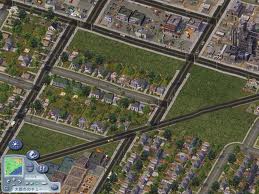
Ever play Sim City?  I must admit, I haven’t done it in like 15 years, but I always loved to watch what happened when you built a neighborhood by an industrial zone, or watch a neighborhood grow when you added a commercial district beside it.

Sim City is a lot like real life in the way something outside a neighborhood can have an impact on what happens within a neighborhood. 

One day several years ago, I was talking to a neighbor who bought her house brand new back in the early 70’s.  We were talking about all the traffic on Pimlico Parkway.  She told me that before they opened Man-O War, the only traffic on Pimlico Parkway was just people from the neighborhood.  It was just the main drag through the neighborhood, like any other entrance and exit  in your neighborhood…..until something changed.

And I guess that is what is on my mind.  How things are always the same, until something changes.

Another example of a road like this is Autumn Ridge Blvd.  I remember when it was a new neighborhood.  You took Autumn Ridge all the way back, turned on Pleasant Ridge just like you do today, only back then it ended before you got to Andover Forest…..and oh, there was also no Hamburg back then either.

Next thing you know, Hamburg is built and you can get to it straight through Autumn Ridge.  It really worked out great for everybody….except those folks that lived on the cut through streets.  They saw a lot of traffic and watched as their houses became less valuable than the same house on a different street in the neighborhood.

So, here is my advice:  Don’t buy a house on a road that ends at an undeveloped area.  SOMETHING will eventually be there….just like on Sim City, and odds are it will change the vibe of your neighborhood.  Sometimes it changes it in a good way, but most of the time it means increased traffic, which usually means increased crime…..just like Sim City.

Here is some more advice:  When you are considering a neighborhood that has roads like that, take a look at a satellite view of the neighborhood.  You want to see what is on the other side of the vacant land to see what may eventually be connected to your neighborhood.  Also, don’t rely on zoning.  I hear people say things like, “Oh, that is zoned for single family, so we’ll be okay.”  Well, lets say that it stays zoned as such.  That doesn’t mean that it will be a single family neighborhood similar to your neighborhood?  But even more of a big deal is that there are zoning changes all the time.

And you know what usually happens when there is a big change in the neighborhood don’t you?  All your neighbors decide to move at the same time.   Never a good thing for resale value……and Game Over for you!