
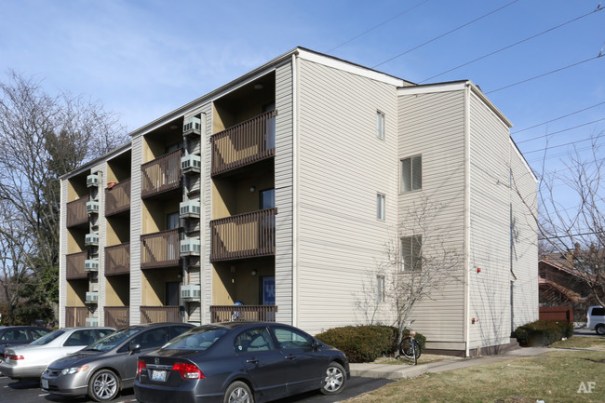
My dream place to live when I was 12

woodland-village-lexington-ky-primary-photo

I rarely go through campus any more, but I found myself stopped at a red light on the corner of Woodland and Euclid this week.  While I was there, I decided to look around rather than checking my phone since I had just done that at the last light.

I found myself staring at this apartment complex.  Back in the early 80s, I was sure I was going to go to UK and live in one of these super cool apartments.  It would be great.  All my friends would come over.  We would do all the things a 12 year old kid thinks college is all about.  It would be Porky’s or Fast Times at Ridgemont High 2.0.  (Google that if you’re younger than 35.)

As a grown up, it made me realize that living there now would be torture.  No way I would want to be on a busy corner with all those students around me.  As the light changed to green, I thought there has to be a blog post in there somewhere.

I kept thinking about the potential post.  As I was waiting to turn left onto Walton Avenue, it dawned on me.  The post should be about how you should always look a little into your future when making real estate decisions.

When I was 18, these 1 bedroom 1 bath apartments would have met every need I had at the time.

When I got married and needed more space than these one car garage sized apartments had, a 2 bedroom apartment met all my needs.

When kids came, I needed a house with a yard.

When we outgrew that, we needed more space and storage.

Now that I am close to being an empty nester, I realize I have too much house.  But I am not moving.  Why?  I am looking ahead.  I’ve had empty nester clients buy a much smaller house than they use to have, only to discover that once grandkids came along, their little ranch was too small.  Their grown children who lived out of town would come visit for a holiday and there was no room for everybody.

Always look ahead to the next phase of life to make sure whatever house you pick will work……unless you want to keep buying and selling for each stage of life.  Which is really okay with me since that is how I make a living.


Best way to negotiate

Most people think negotiating is making the other party do what you want.   That works when one party has the power to force the other into submission.  Like if you’re an 18 wheeler trying to make a slow car get out of your way.  If you’re the President and can threaten nuclear war.  Fist fights.

Not in real estate.  That behavior typically is counter productive because the other party can usually find somebody nicer to work with and still come out better.

It is a seller’s market now.  Sellers have the upper hand since there are fewer houses for sale.  But they still can’t make a buyer do more than the buyer is willing to do.

Negotiating is getting the other party to do the most they are willing to do for you.  You get them there by thinking of which terms are the most important to them.  In a sale, you have price, inspection repairs, what stays with the house, closing date and possession date.  You also have to know which terms you have some wiggle room on.

Sometimes the timeline is more important than a little more money.  When I bought my current house, there were several other offers.  To compete, I asked the listing agent what plans the seller had made for moving.  They had not found a new house yet.  Since I was keeping my old house as a rental, I did not care when they moved out.  They had lived in the house for 20 years and taken good care of it, so I was not worried about them trashing the place.  I wrote the offer with us closing in 30 days and agreed to let the sellers rent back from me until they found a new house.  They stayed for 3 weeks after the closing.  Now, I know not many people can be THAT flexible, but it is a prime example of giving the other party something really appealing that was really of no value to me.  Conversely, I’ve had clients who needed to be in or out of a house on a short timeline.   I’ve even had clients who had a new fridge and let the seller take the one in the house for agreeing to a better price.

I sold a house last night and it is a prime example of good negotiating.  The buyer had a price in mind.  My seller had a price in mind.  It wasn’t the same price unfortunately.  We were $1000 apart.  This was a cash sale.  The house was sitting vacant.  The buyer offered to close sooner than originally stated and agreed to not ask for any repairs unless there was something majorly wrong with the place.

To my seller, this meant less interest to pay for a house to sit vacant.  Less to spend to insure and heat the place in the dead of winter.  No concern for having to do repairs.  All in all, it probably added up to $1000 in saving for him.

So, the buyer got his price and the seller effectively got his price too.  All because the buyer gave the seller something that was not important to him, but was of value to the seller.

This is how it should be done.


3 ways to win in multiple offers

Almost all my listings this year have sold in multiple offers.  That was something to brag about several years ago, but now it is pretty much the norm if the house is priced right from the beginning.

One listing had 7 offers the first day on the market.  Everybody wants the same house these days.

Since only one buyer can get the house, that means that there are others buyers who lost out.  It’s a tough time to be a buyer.

Since my work is almost always split 50-50 between sellers and buyers, want to know how to get the house you want and send all those other buyers off to fight over another one?

  1.  To begin with, go in strong.  There is a difference between overpaying for a house and offering 100% of what it is worth.  An agent should look at the comparable sales and know the value. You are going to pay top dollar for any decent property right now, so write an offer that the seller is likely to just accept.  The more time you waste on negotiating gives other buyers a chance to take the house from you.  Your battle is with the other buyers, not the sellers.  On my listing with 7 offers, we didn’t even consider any of them that had a contingency to sell or those that came in less than full price.  When you have so many good choices, a buyer can often be rejected over something minor.  When I have the buyer, I like to ask the listing agent how they want to receive the offer.  Most of us use an electronic signature program, but some agents don’t.  I mainly ask to show that I am going to be easy to work with.  Keep in mind it is like speed dating for the listing agent-they only have so much time to deal with each offer and the buyer’s agent.  I want to make it as easy as possible for them to pick my client.
  2. Don’t do anything wonky.  If the seller didn’t offer to leave their curtains, then don’t ask for them.  Don’t ask for early possession.  Don’t ask for more time than is normal for the inspections to take place.  This market is not one where you test the seller….unless you want to remain homeless.  A good, clean, simple offer is what all listing agents are wanting.
  3. Think like a seller.  Most sellers these days expect to get around full price for their houses, some even get a little more.  Believe it or not, few sellers actually care about the absolute highest offer.  Usually, the highest offers are really close, so what becomes important are the secondary terms.  The seller is concerned about your financing, so have a preapproval letter from a reputable lender.  They care about how the inspection goes, so schedule it as soon as possible.  The less time they have to worry about that, the better you look.  They care about the closing date, so be as flexible as possible.  I always ask the listing agent when the seller would like to close.  A lot of the time the seller has another closing to coordinate.

You know, I’ve been doing this for 11 years.  It is still awkward for me to write this advice.  It wasn’t too many years ago I was telling sellers how to attract buyers in a tough buyer’s market.  I was telling buyers how to bring a seller to their knees and beg you to buy their house for probably less than they paid for it.  Times change though, and this is where we are now.  And this is what you’ve got to do to get a house today.


Looking at the big picture

Just for fun, I thought I would go through my old blog drafts that I never published for some reason.  I found this one below.  I got a good laugh out of this because I never bought an SUV and I wrote it so long ago that my kids both have their own cars now…..and my dad is retired!

It still makes a good point that is true today:  You’ve got to look at the whole picture when buying a house and any house, unless brand new, will need some of your hard earned money spent on it.

“So, I am thinking about getting a bigger vehicle, maybe an SUV to haul kids to school.  Not too excited about it, so I have a lot of reservations, and find myself trying to make comparisons based more on my perceptions rather than reality.  Then it dawns on me that I am going through the exact same thing that home buyers deal with after they get a home inspection.

See, I am sitting around thinking things like how the tires on my current car have only about 25,000 miles on them, that my brakes are pretty new, and that I just did a major service.  I feel like I am throwing that money away if I were to trade.  Then I realize that I am only looking at half of the whole picture.  If I buy an SUV that still has plenty of life left on the tires and brakes, then I am coming out the same.  Also, since the ones I am looking at all seem to have just over 30,000 miles, they would have just had a major service too.

I think that most buyers deal with something like this after they get their home inspection done.  They start adding the costs of all the problems.  That is natural.  They also usually start to compare the house to other ones they have looked at.  So, at this point I like to try to get them to look at the whole picture like I am trying to do with my car situation.  Lets say House A needs $2000 worth of work on stuff like the roof or plumbing.  House B needs none of those things fixed, so House B must be the better one to go with, right?  Well, House B needs fresh paint, and it will also cost $2000.   When I put it this way, I am sure you see that $2000 is still $2000 no matter how you spend it. (Now I know I have over simplified here, and that most buyers have a chance to ask the seller to make repairs, but this was just the easiest way to make a point.)

My dad is the master of looking at the whole picture.  Seems like most of his friends and family always come to him seeking advice.  The funny thing is that I don’t think he ever really gives advice.  He seems to lead you to the obvious conclusion by asking a series of questions.  He’s like the compassion of Mother Teresa and the wisdom of Yoda wrapped up in a motorcycling, pet loving lawyer.

So, by looking at the whole picture about my car situation, I can now go forward to the next step, which is to decide if it is really something I want to do.  When you get to this point of the home buying process, keep in mind that just about any house is going to need money spent on it somewhere, then decide what you can live with and what you can’t.

What makes a good location?

This week, I’ve been listening to several different buyers tell me what part of town they want to be in.  It has had me thinking about the whole “Location Location Location” thing.  I think most of the time, we as people like to reduce things down to a yes/no, for/against, good/bad scenario……Like this is a good location and this is a bad one.  I just don’t think it is that simple and here is why.

Just this week I’ve had two people tell me they really want to be in a location that many people avoid.  This is a high density area, so the buyers are looking for townhouses and condos.  See, the people that think this is an area to be avoided don’t want to be in that kind of density and are single family home types.  Both buyers mentioned that they had lived in that area before and liked how easy it was to get any where in town and that they enjoyed the 30+ acre park in the middle of the area.  When my wife and I were newlyweds, we lived in this area too…..we thought the same thing back then.

I guess my point in all this is that what makes a good location is really a subjective thing that varies greatly.  Age, income, property type, etc, all greatly have an impact on what makes a location appealing.  There is one common thing that all people tell me they want in a location:  Proximity to work, businesses they shop at, restaurants they eat at, and things like parks/sports/ or places they frequently go.  People with kids like to be in a good performing school district too.

Lexington is big enough to support all these different opinions about what makes a location good.  It is all in the eye of the buyer, and if enough of them think it is a good location, then it must be.